
Journal

Why Your Coffee Shop's Bathroom Is Nicer Than Your Apartment

The absurd truth about cafe bathroom design, the Instagram-ification of public spaces, and what it reveals about how we live now.

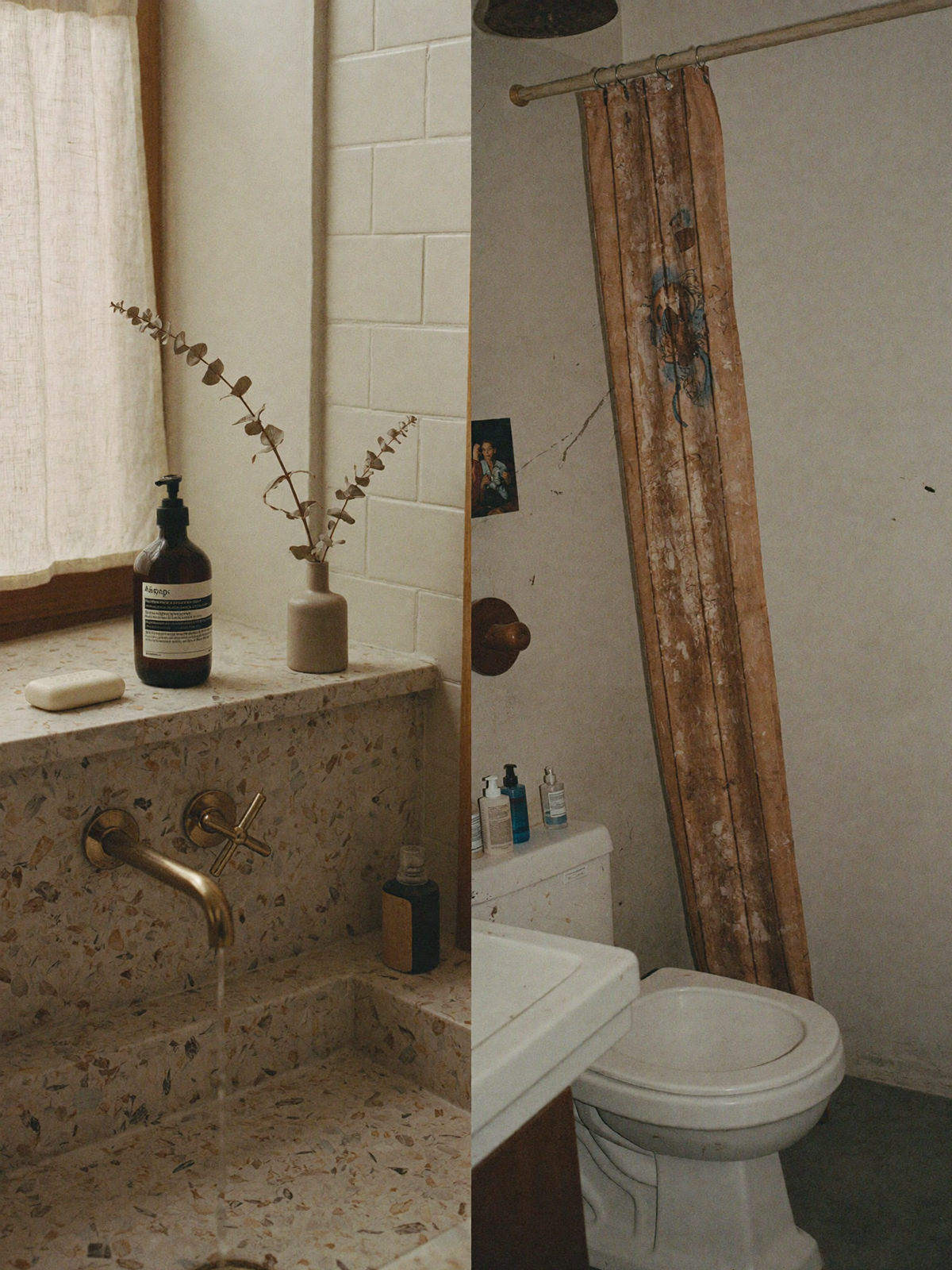
You walk into a café in Mid-City on a Tuesday morning — nothing special, you're just grabbing your cortado — and your bladder makes the executive decision. You head toward the back, push through a door, and suddenly you're in a bathroom that has no business being this beautiful. Hexagonal tile. Aesop soap in a refillable pump bottle. A succulent in a handmade ceramic pot on a floating shelf. Warm Edison bulbs that cast light the way a Renaissance painter would if he were also a lighting designer with $40,000 and something to prove. The mirror doesn't make you look like a corpse. The hand towels are linen. Linen. There's a framed photograph of a tree. You're standing in a room the size of a closet that has more intentional design choices than your entire apartment.

And you don't even work here.

This is not an exaggeration. This is the great unspeakable truth of 2020s urban culture: the bathroom at your neighborhood coffee shop is, statistically, a more thoughtfully designed space than anywhere you sleep, eat, or actually live. Somewhere between the collapse of third spaces and the rise of the "Instagrammable moment" economy, café bathrooms became the unexpected battleground of interior design taste.

1. THE ARMS RACE: How a Toilet Became a Luxury Good

Five years ago, a decent coffee shop bathroom was basically: white subway tile, maybe a recessed light, the kind of soap that smells like a hospital made a terrible decision. Functional. Forgettable.

Then something shifted. Someone — a café in Brooklyn, probably, or maybe LA — decided that the bathroom could be a statement. Not just about the café's commitment to cleanliness, but about taste. About intentionality. About the idea that every square inch of a space you encounter should reflect some aesthetic philosophy.

And once that happened, it was war.

Now walk into any competently designed specialty coffee shop and you're in a bathroom that has cost its owner more per square foot than some neighborhoods' average rent. The tile is never generic. The fixtures are brass or matte black. The lighting is a $400 vintage sconce. There's always a plant. The mirror is positioned to be flattering.

The soap — oh, the soap — is a paragraph unto itself. Aesop (starting at $40), or D.S. & Durga, or a bespoke soap made by someone who has a Substack about botanical ingredients. The soap is frequently more expensive than the coffee you're drinking.

For a bathroom.

In a place you visit for maybe 45 minutes.

And the truly maddening part? It works. You feel better in that bathroom. You're more inclined to return to that café. The café has successfully weaponized comfort into a competitive differentiator.

2. THE INSTAGRAM FACTOR: Why Your Apartment Looks Like It Was Furnished by an Algorithm

Here's the thing you need to understand about modern consumer behavior: We curate the spaces others see before we curate the spaces we actually live in. Your apartment is probably functional. Probably a little cluttered. Definitely has that chair that used to go somewhere else and now just kind of lives in the corner.

But your Instagram aesthetic? Immaculate.

Coffee shops have learned to monetize this impulse. They've understood that in an attention economy, every inch of the space is either a potential piece of content or a missed opportunity. The bathroom is content. The floor is content. The water glass has to be content.

This is the economy we're living in: An economy where public spaces have become so aestheticized, so carefully curated, so relentlessly photograph-able that they're now more beautiful than the private spaces where we actually spend most of our time.

3. THE COMFORT INDUSTRIAL COMPLEX: When Ambiance Becomes a Product

We've outsourced comfort to public spaces because private comfort has become economically unfeasible. Your apartment is small because rent is impossible. But you can experience comfort — real, intentional, carefully designed comfort — by paying $6 for a cappuccino and sitting in someone else's vision of what comfort should look like.

This is the actual business model: The café isn't selling you coffee. It's selling you the experience of being in a well-designed space. The coffee is the excuse to stay. The bathroom is the proof that they've thought about every detail.

The genius part — and it's dark genius — is that this actually is more equitable than the alternative. If you're rent-burdened and can't afford a beautiful apartment, at least you can experience beautiful spaces for the price of a coffee. The café democratizes comfort.

Except this also means your life has been reorganized around paying strangers for access to comfort that you should be able to find at home.

4. THE ABSURDITY AND THE SINCERITY

Look. We have to acknowledge something here. Jurassic Magic also has bathrooms designed with intention. Not quite at the "Aesop soap in a brass pump bottle" level, but we care about the space. We've thought about the paint color. The lighting matters to us.

The difference — and maybe this matters, or maybe I'm just trying to justify my own complicity — is that we're aware of the absurdity. We can hold both ideas at once: Yes, a bathroom is a bathroom. You use it to pee. But also, why shouldn't it be beautiful while you're doing that?

There's a tenderness in paying attention to small spaces. There's something that's not cynical about saying, "Okay, someone is going to spend two minutes in this bathroom. What can we do to make those two minutes feel like they matter?"

(Though yes, also, it's a little bit Instagram capitalism. It can be both.)

The best café bathrooms aren't trying to be beautiful for the algorithm. They're trying to be respectful. They're trying to say, "We took your five minutes seriously enough to make them pleasant."

The trap is not in caring about design. The trap is in designing exclusively for the external gaze.

5. THE BROADER INFECTION: How Public Spaces Became More Real Than Private Ones

This bathroom thing is a symptom of something larger: the increasing aestheticization of public space and the corresponding neglect of private life. Walk through any neighborhood and what you see is a sequence of beautifully curated storefronts. Then you walk into the building behind the storefront and it's residential hallways with flickering lights and worn carpet.

This used to be the opposite. Homes used to be where you invested. Public spaces were utilitarian.

Now? The equation has flipped. Public spaces have become the stages where identity performs. Your apartment is a dormitory. The café is your actual living room.

The bathroom is just the most visible evidence of this inversion. A stranger's toilet is more beautiful than your own, because the stranger invested in making it so.

6. THE TURN: What a Beautiful Bathroom Actually Means

Here's where it stops being funny and starts hurting a little — I think the café bathroom arms race is also, underneath all the capitalism and the Instagram-ification, a genuine attempt at care.

Someone made a choice. They looked at a utilitarian space and said, "What if we treated this like it mattered?" They spent money they could have spent elsewhere. They thought about what would make someone feel better, even briefly.

That's not nothing.

The problem isn't that cafés care about their bathrooms. The problem is that we've made it so that the only way to experience genuinely beautiful, thoughtfully designed space is to pay for access to a commercial property. The problem is that your home is so expensive that you can't afford to design it with the same care.

The bathroom reveals a failure of economics. It reveals that we've accepted that only public spaces deserve to be beautiful, and only if beauty serves a business model.

That's the part that hurts.

7. THE ACCIDENTAL REVOLUTION: What It Means to Care About a Bathroom

And yet — there's something kind of beautiful in the fact that someone cares this much about a bathroom. In an economy that generally doesn't care about your comfort unless you're paying for it, a café owner who spends money on good soap and nice tile is doing a small, defiant thing.

In a world designed primarily for extraction and efficiency, a well-designed bathroom is a quiet rebellion. It's someone saying, "No, this space will not be brutalist. This space will be kind."

The real issue isn't that café bathrooms are beautiful. The real issue is that your apartment can't be. The real issue is structural. It's about rent. It's about how much of your income goes to housing.

The solution isn't to stop caring about bathrooms. It's to extend that care backward, into private life. To insist that beauty isn't a luxury good.

That feels radical only because we've forgotten how normal it used to be.

8. THE CLOSE: The Radical Act of Staying Home

What would it mean if the best-designed space in someone's life was their own apartment? That's not a question about aesthetics. That's a question about how we live, and what we value, and whether comfort is a right or a luxury.

The café bathroom is beautiful because someone looked at a utilitarian space and said it mattered. Someone said: these five minutes matter. This small room matters. The person washing their hands matters enough to give them soap that smells good and light that flatters. That's not nothing. That's care.

The tragedy is that this same care doesn't extend to the spaces where we actually sleep, eat, think, and grieve.

But maybe noticing this is the first step. Maybe the café bathroom can be a reminder of what we're capable of when we actually pay attention. When we say that a space matters. When we choose care over efficiency.

Your apartment could be that beautiful. It should be. The fact that it isn't is because we've let the economy convince us that our private lives are worth less design attention than a for-profit bathroom.

Some rooms exist to make you better, faster, richer. But some rooms should exist just to let you be still. To let you notice what you already have. Those rooms matter most of all.


FAQ

Q: Are you saying coffee shop bathrooms are bad?

A: No. The problem isn't that café bathrooms are beautiful — it's that home bathrooms aren't given the same care. Don't blame the café for trying. Blame the system that makes your apartment unaffordable to design.

Q: Doesn't Instagram culture mean people just want to photograph bathrooms?

A: Some people, sure. But maybe that's okay? If someone posts a photo of a beautiful bathroom and it makes them feel good about the small beautiful things in the world, that's not the worst use of Instagram. The problem is structural, not individual.

Q: Does Jurassic Magic have expensive soap in its bathrooms?

A: We have nice soap. Is it Aesop? No. We're a coffee shop in MacArthur Park and Mid-City, not a venture-backed startup in Silver Lake. But we care about the space. We think about the lighting. We're okay with that contradiction.

Q: What should I do about my apartment?

A: If you can afford to, invest in it the way a café designer would. One beautiful thing at a time. A plant. Good lighting. But also — organize politically. Push for housing policy that makes design possible for regular people. The real answer isn't DIY aesthetics. The real answer is economics.

Q: Is this post just you justifying Jurassic Magic's Instagram-friendly bathrooms?

A: Possibly. Probably. But also, yes, we want people to feel good when they're here. Is that capitalism? Yes. Is it also care? Also yes. You can hold both ideas at once. In fact, you have to.

Visit us today
 Explore our cafés, events, and community